

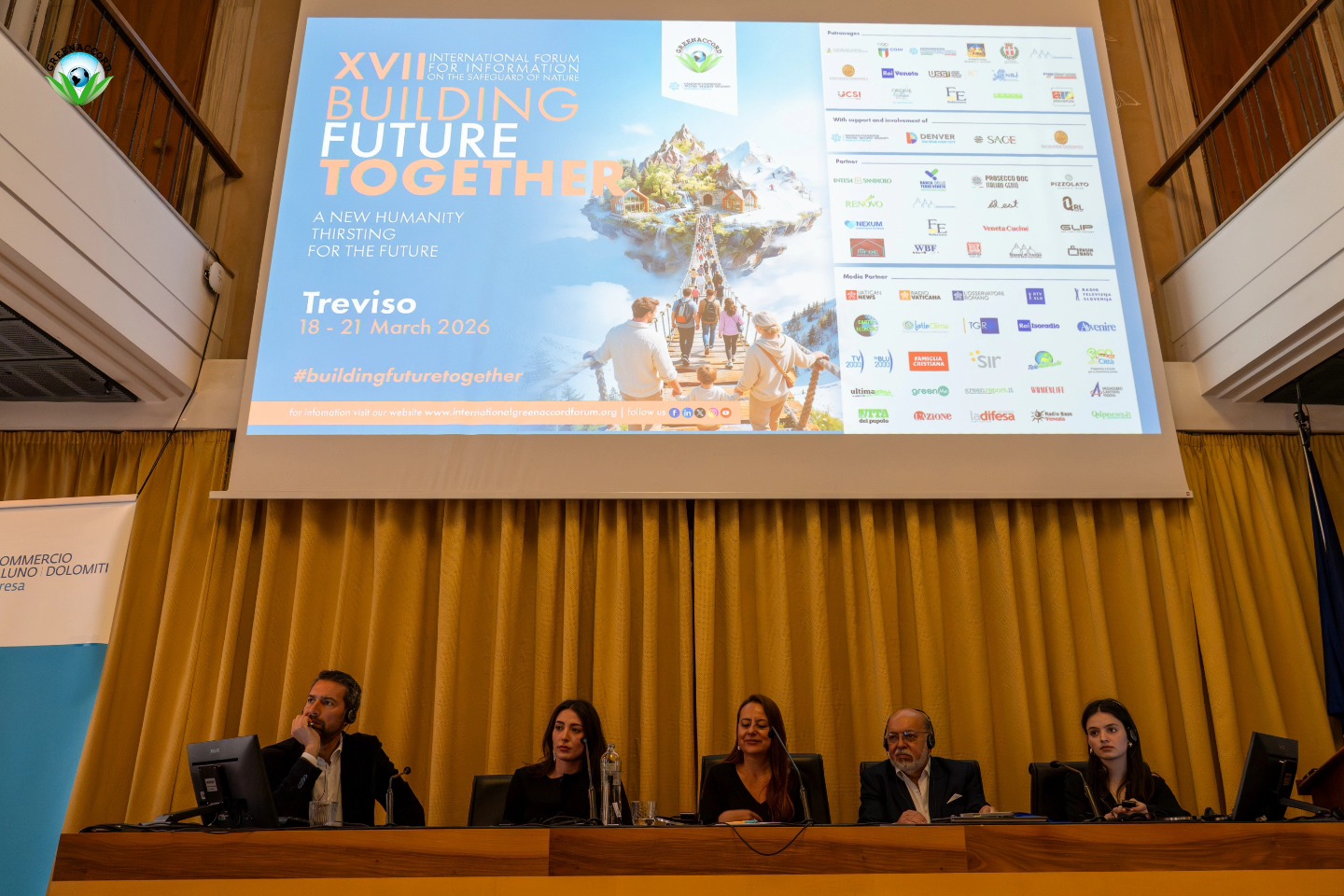
Reflections on the outcomes of the latest Greenaccord International Forum held in Treviso, Italy, 18-21 March 2026
As Alfonso Cauteruccio, president of Greenaccord, said, in these times marked by conflict, geopolitical uncertainty, and climate crisis, we should speak of “integral ecology”—a vision that reconciles the environment, social justice, and the economy.
Perhaps the most important conclusion that we, the participants in this Forum, have been able to draw is the importance and necessity of maintaining an open dialogue on the environmental crisis among the various sectors of society—economic, political, academic, health, arts, press, sport—despite differing perspectives and interests. Despite the obvious disagreements among these sectors.
It is not always easy to reconcile business interests with sustainability. Within the prevailing capitalist model of our time, a company pursues profit—there is no doubt about that. But today, even the most polluting companies have come to recognize the ecological toll of their operations. That is why, alongside their business operations, they promote projects and programs aimed at benefiting the environment—methods to reduce carbon emissions, recycle waste, or educate young people to address today’s climate challenges. But the truth is that, in most cases, the benefits of these programs are very meager compared to the environmental damage caused by their economic activity.
For those of us who wish above all to emphasize the importance of caring for nature and maintaining biodiversity, we cannot, however, simply dismiss the business interests that provide jobs for communities, promote regional development, and foster education and growth. At the same time, we cannot set aside our critical spirit when economic interests clearly outweigh ecological ones, when the pursuit of material gain takes precedence over social, cultural, and environmental considerations. Because a mine must not be opened—even if it provides employment for a certain number of people—in a place inhabited by a population that depends on its land and water for survival.
There has been talk for some time now about sustainable development, a concept created by the United Nations in the 1980s, according to which “sustainability” is the practice of maintaining productivity from natural resources without degrading or endangering natural biological systems. Strictly speaking, I think it’s fair to say that perfect sustainability does not exist. But it’s also true that some economic activities are more sustainable than others. A wind farm, for example, has much less of an impact on the environment than an oil field.
What needs to be done is to ensure that the most polluting companies actually follow through on their sustainability commitments in their business operations. The so-called “green development” that some governments and companies claim to practice must truly live up to their stated goal of protecting nature. Business people tend to see only the economic value of nature. It is high time they considered that value in harmony with nature. Because a land contains not only raw materials but also plants, animals, and human populations.
At the Treviso Forum, examples were presented of various initiatives that some major companies are undertaking in the fields of the arts, music, and culture in general, with the aim of raising awareness among the public —especially among young people— of our collective responsibility regarding global warming, environmental pollution, and so on. These initiatives aim to show people that nature is very beautiful, that cities should be greener, and that it is possible to construct buildings, houses, doors, and windows using biodegradable materials that do not harm health or the soil. All of this is very good, but it is still not enough. The business world could do much more.
The Forum’s theme was: “Building a Future Together – A New Humanity Thirsting for the Future.” Today’s young people are uncertain about their future. Pessimism about the future prevails. Life feels meaningless. The effects of climate change have led to the emergence of new mental health issues, such as eco-anxiety. As Alfonso Cauteruccio, president of Greenaccord, emphasized, in these times marked by conflict, geopolitical uncertainty, and the climate crisis, we must speak of “integral ecology” —a vision that reconciles the environment, social justice, and the economy.
We must adopt a constructive attitude. We must build bridges. We must continue to pressure private companies to do more, to truly and consistently assume their share of responsibility, and to be willing to reduce their profits if that will lead to a better future for next generations, including the children and grandchildren of CEOs.
Amira Armenta
 BLOC DE NOTAS